Almandine
sold- Locality
- Chycornish Carn, Botallack, St. Just, Cornwall, England
- Minerals
- Almandine
- Dimensions
- 5 x 3.7 x 1 cm
- Size class
- Miniature
- SID
- MK621
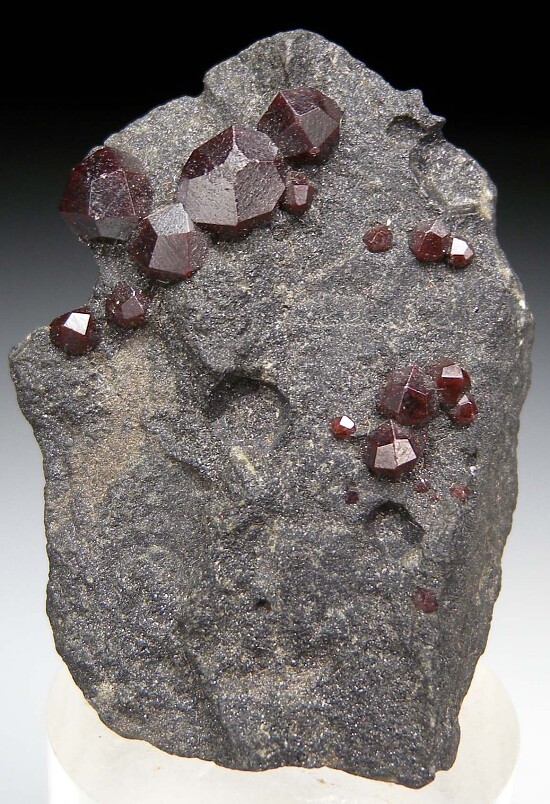
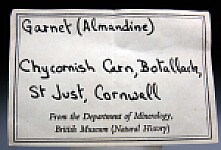
Well formed red Alamandine crystals to 7mm in a dark schist matrix. These are rare, hard to come by specimens from a one time find. Ex. Tim Sherburn collection and comes with an old British Museum label. Tim specialized in UK minerals and he told me these were the only UK garnets he was ever able to buy. A discussion of the find and locality is provided by MINDAT: In 1822, Carne notes: 'About six months ago, a mass of beautiful garnets, of a deep red colour, was found imbedded in the rock [in a footnote: The rock here appears to contain chlorite, as well as hornblende and quartz], not far from low water mark, at the foot of Chycornish Carn, about a quarter of a mile south of Botallack. Some of the crystals are larger than hazel-nuts, and most of them were twenty-four sided. Some specimens of a very superior order were procured, each having from one to two hundred crystals on its face.' There is, however, some debate about the true locality of these specimens, some of which are preserved in the collection of the British Museum of Natural History. Chycornish Carn is an isolated rock in the sea, about 40 yards off Crowns Rock, north-west of the Botallack mine. According to Carne, however, the specimens were recovered from a place located a quarter of a mile in the opposite direction. Whether this is just a simple mistake in the locality description is not known. Comparable specimens were never found again, neither at Chycornish Carn, nor anywhere else in the area around Botallack Mine. On the other hand, Carne's report suggests that the locality was collected out, a fact which still leaves Chycornish Carn as the possible location.For these reasons, the locality is listed with a question mark. The grid reference is that of Chycornish Carn. Alderman (1935) characterised specimens of these garnets in the Carne Collection at the University of Cambridge. He mentioned that (Sir) Arthur Russell succeeded in discovering the original spot where these garnets were obtained, and that all the garnet specimens have been removed, save for traces. Russell indicated the location was near the low water mark on the cliffs close to Zawn a Bal, between the Crowns and Wheal Edward. Analysis of the garnets showed them to be unusually rich in the almandine component with 91.33% almandine, 1.69% spessartine, 2.35% pyrope and 4.63% grossular.